Thursday night, 21 May 2026 (2 days ago as I write this), I watched the last episode of The Late Show with Stephen Colbert.[1] Cancellation of the show was controversial and largely assumed to be the result of pandering to the POTUS in light of a government-okayed media merger.[2] Afterwards, I heard some disappointment about the lack of anticipated vitriol against the POTUS and his administration. My take was that Colbert’s not-so-much-as-mentioning the president’s name was an intentional theme. This got me thinking about a more famous, but subtle and extremely effective, “dis by silence:” the Exodus account and the pharaoh. Who was that guy?
A Megalomaniac’s Megalomaniac
Most Egyptian kings (pharaohs) were ardent self-promoters, especially in the Late Bronze Age (c. 1550-1200 BC), the time of the Egyptian New Kingdom. This is most obvious in construction projects, particularly buildings at religious sites on which they could place their names and self-laudatory proclamations.
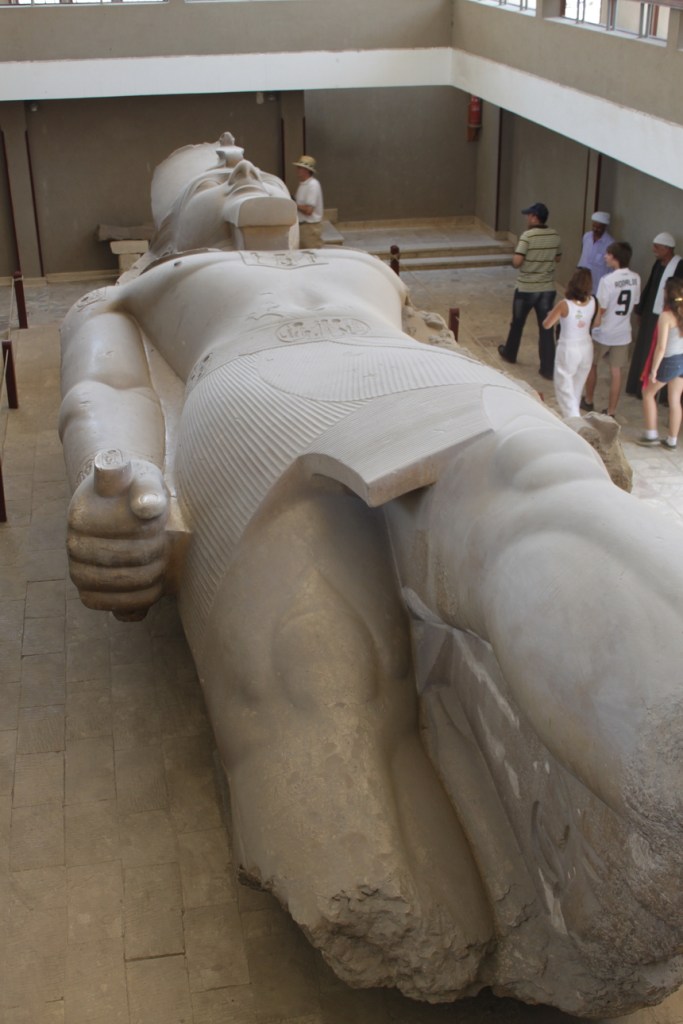
(tourists added for scale)
(© Daniel C Browning Jr, 2010)
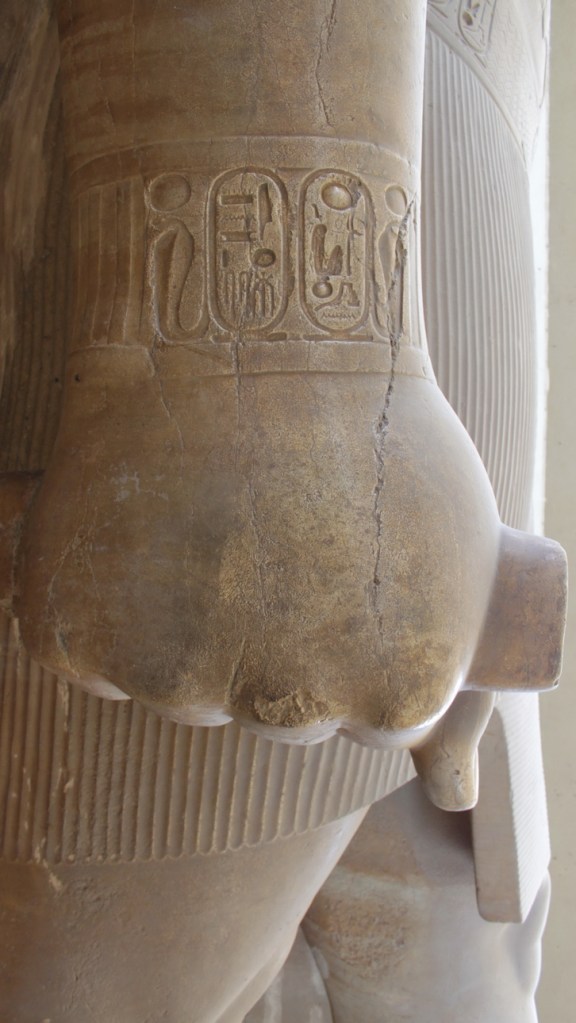
(© Daniel C Browning Jr, 2010)
The most enthusiastic pharaoh in terms of self-aggrandizement was, without doubt, Ramses II (ruled 1279-1213 BC). More than any other king, he “left his mark” on Egypt and its monuments;[3] the latter in the form of his two cartouche names (enclosed in ovals),[4] which are ubiquitous on his own and earlier monuments. Because of his long rule and the volume of megalomaniacal material, selected relevant aspects of his reign follow in bullet form:
- He modified or built temples to deities throughout Egypt. These included several major ones: the temple of Ptah in Memphis; large additions to the temples of Amun-Ra at Karnak and Luxor, in Thebes; the Osiris temple at Abydos, and the familiar complex at Abu Simbel.
- Ramses II built a huge funerary temple to himself, the Ramesseum across the Nile from Thebes.
- He expanded his father’s palace in the Delta to a full capital city and named it after himself; Pi-Rameses (“domain of Ramses”)
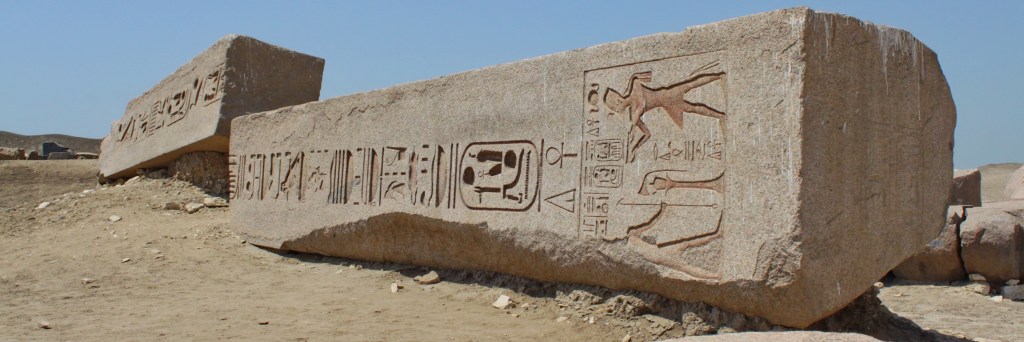
- Ramses exaggerated his accomplishments. This is most obvious in three accounts of one of his several foreign wars, the ill-advised Battle of Qadesh against the Hittites. The campaign was hampered by bad intelligence and was a near disaster. At best, it ended a draw, with the geopolitical situation the same as before the conflict. Nevertheless, Ramses proclaims it a great victory at major temples in multiple copies of labeled relief depictions, a chronicle, and a poetic paean, in which he is the great hero.
- After his war with the Hittites, he styled himself a peacemaker by trumpeting a treaty with the Hittites, which basically reaffirmed the status quo.
- He modified earlier works of others (including his own father’s) and placed his names (cartouches) on them.
- Colossal statues of Ramses II were erected at several temples and the Ramesseum. In these, he appears larger than the gods themselves and dwarfs his wives and children.
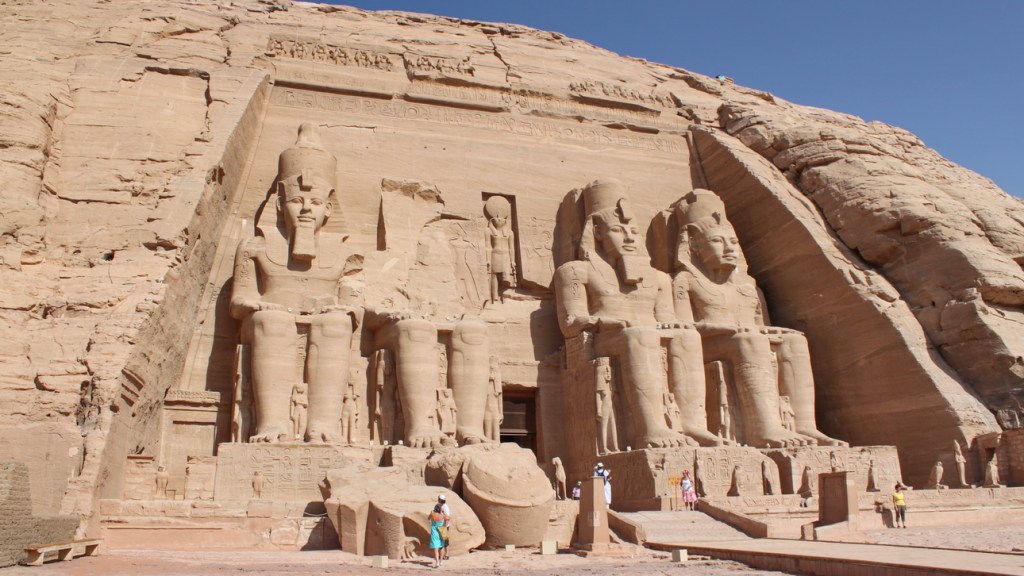
- On the topic of wives and children, he sired over 100 of the latter by multiples of the former. To be fair, he did have an ultra-long reign and lived to about 90. His age is often cited as the reason some of his children were born by his own daughters—to insure the line of accession. It is worth noting here that the Late Bronze Age ultra-rich (i.e., kings of major empires) traded in women as commodities, at times resembling an ancient sex-trafficking system[5] (is all this sounding creepily modern and familiar?).
- Ramses II regularly depicted himself as a god. While it is true that the Egyptian word for “king” and “god” are the same word, most kings were only worshiped as gods after death. But Ramses II is one of the very few kings worshiped as such while living. This bit would (and should) have been the most distasteful to the Israelites and certainly the writers of the Hebrew Bible, with their strict view of monotheism.
The Exodus Account
This brings us to the Exodus story and the Bible’s treatment of the king to whom Moses delivered the message from God, “set my people free.” That pharaoh is curiously, and frustratingly to historians and biblical scholars, not named in the Hebrew Bible text. While there has been much debate about his identification, scholars who understand the history behind the account and also agree that some kind of Exodus event occurred concur that it must have occurred in the early-to-mid 13th century BC; that is, during the long reign of Ramses II.[6]
Thus, the perplexing omission by the Hebrew Bible of the most famous and promoted name of the period in which the Exodus would have occurred. One frequent objection to a historical Exodus is based on this fact. I, however, contend that the opposite is true: the name of the king is left out as the ultimate put-down for the man who brashly plastered his name on everything. Note some contrasts:
- The Exodus story emphasizes the revelation of God’s personal name, Yahweh, through Moses to his people (Exodus 3 and following). Meanwhile: the king remains anonymous.[7]
- The midwives, low status care-givers that defy the king’s immoral orders, are provided with memory through names in the Exodus account (Exodus 1:15-22). Meanwhile: the accomplished great king is undesignated.
- Yahweh is shown as the only true God, and the “Sinai Tradition” emphasizes his role as king over Israel (Exodus 19:5-6; Numbers 23:21; 24:5-8). Meanwhile: the self-proclaimed god/king of Egypt loses his name and his control. One might also argue that the prohibition of “graven images” (for those who may not know, this is one the Ten Commandments) was, in part, a response to the dangers of megalomania as exemplified by Ramses II.
So, the book of Exodus magnifies the name of Yahweh and, in a glaring omission, erases the then-prevalent name of the self-proclaimed god/king of Egypt, as comparatively insignificant. I prefer to imagine that Stephen Colbert has done something similar with his last show, leaving a record of positive accomplishment with hope for the future[8] and devoid of a tirade against or even the name of a lesser person. I will miss The Late Show with Stephen Colbert. It was a class act.
Epilogue
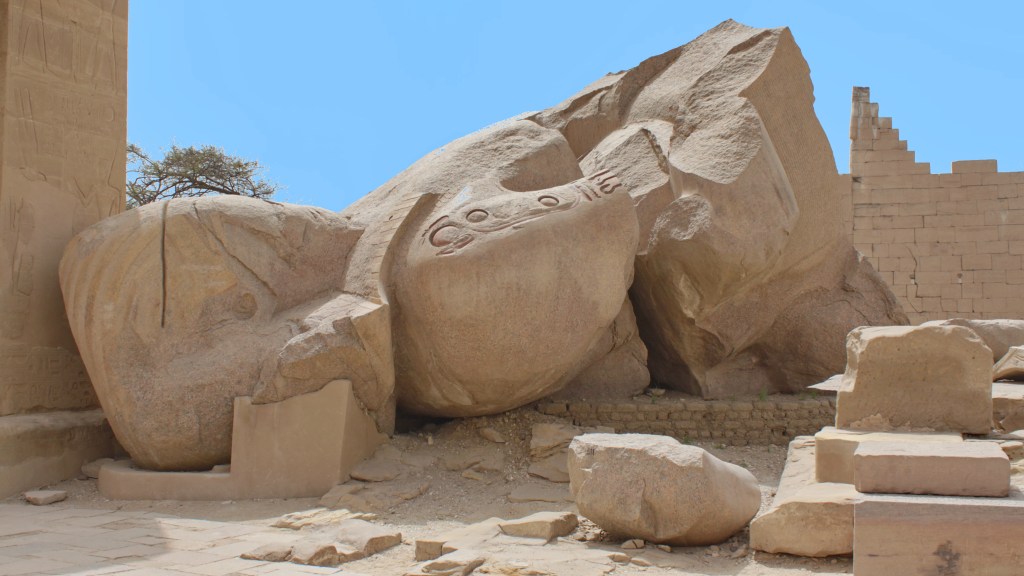
“But wait!” . . . you may well object. Did Ramses II not also succeed in leaving a record of his greatness? Sort of . . . But his memory had to be resurrected; not by God, but by archaeologists. By the end of Antiquity, Ramses’ buildings had become desolate ruins, his bluster faded, and his name was largely forgotten. To wit; note the words of Percy Bysshe Shelley in his famous 1818 poem, inspired by news that one of the broken colossal statues of Ramses II at the Ramesseum was coming to the British Museum. The poem is ironically misnamed through a Greek corruption of the king’s first cartouche name:
Ozymandias
I met a traveller from an antique land
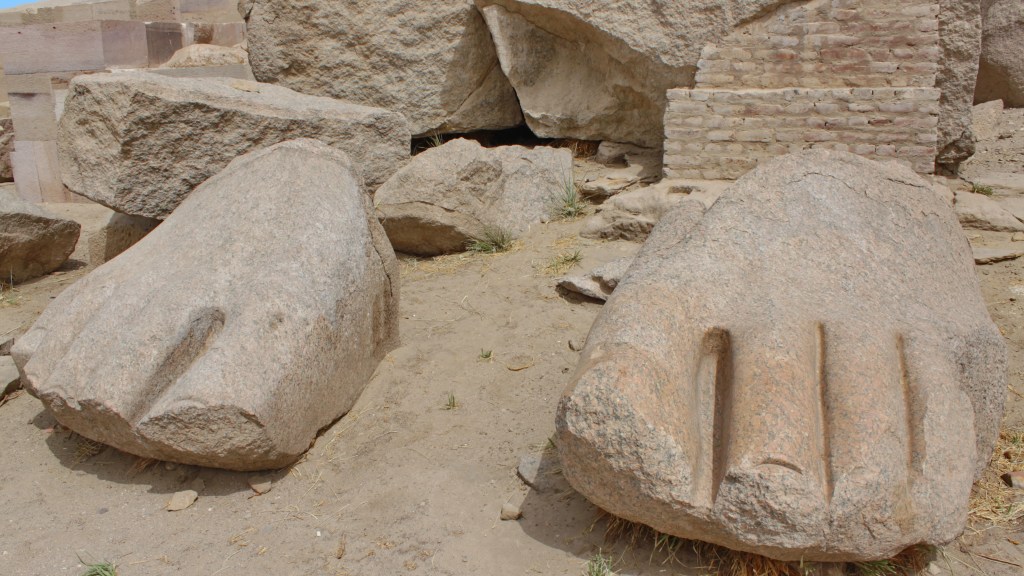
Who said: Two vast and trunkless legs of stone
Stand in the desert…. Near them, on the sand,
Half sunk, a shattered visage lies, whose frown,
And wrinkled lip, and sneer of cold command,
Tell that its sculptor well those passions read
Which yet survive, stamped on these lifeless things,
The hand that mocked them, and the heart that fed:
And on the pedestal these words appear:
'My name is Ozymandias, king of kings:
Look on my works, ye Mighty, and despair!'
Nothing beside remains. Round the decay
Of that colossal wreck, boundless and bare
The lone and level sands stretch far away.

Thanks for looking! (Read the footnotes)
[1] The Late Show With Stephen Colbert, Season 11, Episode 118, CBS, May 21, 2026, https://www.cbs.com/shows/the-late-show-with-stephen-colbert/.
[2] For all that, see Wikipedia contributors, “Series finale of The Late Show with Stephen Colbert,” Wikipedia, The Free Encyclopedia, https://en.wikipedia.org/w/index.php?title=Series_finale_of_The_Late_Show_with_Stephen_Colbert&oldid=1355691262.
[3] For a good overview, see K. A. Kitchen, Pharaoh Triumphant: The Life and Times of Ramesses II, King of Egypt (Warminster: Aris & Phillips, 1982).
[4] His throne, or Nesu-bity name, Usermaatre Setepenre (“The Justice of Re is Powerful, Chosen of Re”); and his given, or “Son of Ra” plus epithet name, Rameses meryamum (“Re has begotten him, Beloved of Amun”); see, conveniently, Peter Clayton, Chronicle of the Pharaohs (Thames and Hudson, 1994), 146, 218.
[5] Madeleine M. Henry, “The Traffic in Women: From Homer to Hipponax, from War to Commerce,” in Greek Prostitutes in the Ancient Mediterranean, 800 BCE–200 CE, edited by Allison Glazebrook and Madeleine M. Henry. Wisconsin Studies in Classics. (University of Wisconsin Press, 2011); For multiple cases documented in the Amarna Letters relating to Egypt, see Willam L. Moran, The Amarna Letters (Johns Hopkins, 1992), especially EA 2-4, 11, on princesses sent as royal wives; for other women, see EA 369 (in apparent answer to EA 271!).
[6] See James K. Hoffmeier, Israel in Egypt: The Evidence for the Authenticity of the Exodus Tradition (New York: Oxford, 1997), esp. pp. 122-26.
[7] The name Ramses appears only in the name of one of the cities built by the Hebrew slaves, Raamses; clearly a reference to Ramses II’s new capital.
[8] For a review of the final episode and links, see https://www.nytimes.com/2026/05/22/arts/television/stephen-colbert-series-finale.html?unlocked_article_code=1.klA.pDcd.zCmcxpN5uHMh&smid=url-share


